Home › Services › Commercial Restoration in Wellington, FL
Commercial Restoration in Wellington, FL
Lede: A commercial loss is measured in days closed, not gallons of water. Commercial restoration in Wellington, FL is built around that one fact: a clubhouse with a burst line during event season, a barn aisle under water, a store on Forest Hill Boulevard with a ceiling coming down. We scope the loss, phase the work around your operation, and document every step for the people who will ask you about it later.
Who commercial restoration in Wellington, FL serves
H2: Commercial restoration in Wellington, FL for HOAs, barns, retail, and offices
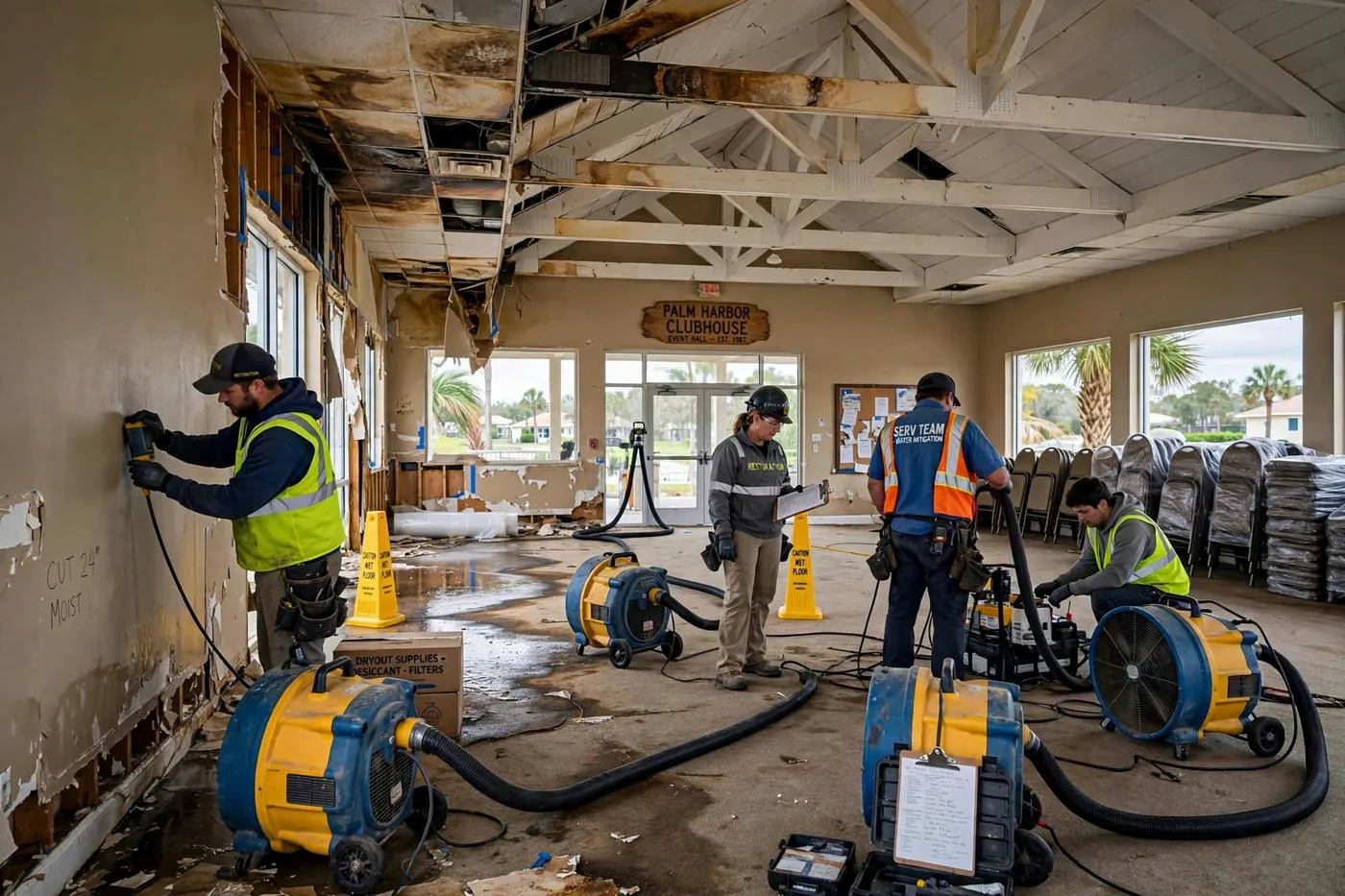
Our commercial work falls into three groups. The first is community property: HOA clubhouses, amenity centers, fitness rooms, and guardhouses across Wellington's gated communities, where one leak can close the building an entire neighborhood uses. The second is equestrian: barns, wash racks, tack and feed rooms, and arena offices, the working buildings of the horse industry here. The third is business space: retail and restaurants along Forest Hill Boulevard, Wellington Trace, and the State Road 7 corridor, plus professional offices throughout the village.
The damage itself is familiar. Water does most of it: supply lines, water heaters, AC condensate, and roof leaks in buildings that run hard all summer. Then fire and smoke, storm damage in hurricane season, sewage backups, and mold in buildings where the air conditioning never really rests. The difference from a home is not the water. It is the number of people the closure touches.

How we keep you open
H2: Downtime-first: the job is planned around your operation
1. One call, one contact. A property manager or board member deals with a single point of contact from the first scope to the final walkthrough. No relay race of project managers.
2. A written phasing plan. Before work starts, you see what closes, what stays open, and in what order. A clubhouse with a working half is worth more than a clubhouse "almost finished" everywhere at once.
3. Containment first. Work zones are sealed and kept under control so unaffected areas of the building keep operating safely beside them.
4. Scheduling around your calendar. Phases are set around clubhouse events, retail hours, and show schedules, including work windows outside your public hours when that is what keeps your doors open.
5. Documentation as we go. Photographs, moisture readings, and progress notes a manager can forward to a board or an insurer as written.
6. The sign-off walkthrough. We walk the finished space with you and close the documentation file in the same pass.
Wellington's commercial reality
H2: Show season, gated access, and boards that meet monthly
Wellington commercial work has a local rhythm. During the winter equestrian season, the barns and facilities around the show grounds run at full capacity for months, and a water loss in season is not an inconvenience, it is a schedule emergency for horses, staff, and clients at the same time. We plan equestrian work around the reality that animals cannot simply be sent home: affected stalls and aisles are sequenced so horses move once, not daily.
Community property runs on governance. HOA boards approve scopes, architectural committees have their say, and every gated community logs access. We build that into the plan: scopes written for a board to approve, access coordinated in advance, documentation formatted for the monthly meeting.
The retail corridors have their own pressure. A closed store on Forest Hill Boulevard or Wellington Trace loses the day's trade and the regulars who find another door. Ground-floor spaces near the lakes and canals along these corridors also sit low, and they take water first when summer storms outpace the drainage.
Large losses
H2: Large losses, without the big talk
Plenty of companies advertise large-loss divisions. What actually matters, when a whole clubhouse floor or a full barn is wet, is simpler: a fast honest scope, drying scaled to the building instead of a fixed package, trades coordinated so nobody waits on anybody, and documentation that holds up when the file gets reviewed months later. That is the work we do. If a loss turns out to need resources beyond ours, we will tell you on day one, not week three.
Cost factors
H2: What the cost depends on
Commercial cost turns on the square footage affected, how tight the phasing has to be, how much containment the open areas require, the contents involved (clubhouse furnishings and retail stock add a pack-out to the job), and how much of the work has to happen outside your operating hours. You receive a written scope and phasing plan before work begins.
Our documentation is built for insurers and boards alike, and it is yours either way. Whether a policy responds to a loss is the insurer's decision. For background on how restoration costs build up, see our water damage cost guide.
Related services
- Water damage restoration: the same extraction and drying discipline, scaled from homes to commercial buildings.
- Storm damage restoration: hurricane-season damage, tarping, and board-up for commercial roofs and storefronts.
- Contents cleaning: pack-out and inventory for clubhouse furnishings, retail stock, and office contents.
Frequently Asked Questions
Can you work while we stay open?
Often, yes. Phasing and containment exist for exactly that reason: the affected zone closes, the rest of the building operates. Some losses are too large or too contaminated for that to be safe, and if yours is one, we will tell you at the scope stage.
Who do our residents, members, or customers talk to?
You. Our crews work inside the sealed zone and direct every question to your manager or front desk. One contact on our side, one on yours, and nothing improvised in between.
What documentation does our board or insurer receive?
The written scope and phasing plan, photographs before, during, and after, moisture readings through the drying, progress notes as the job runs, and a final summary at sign-off.
A barn aisle flooded during show season. What matters most?
The horses. Affected stalls are cleared first and horses moved once, to dry ground, before extraction starts. Then the water source is confirmed stopped, bedding comes out, and wash racks, tack rooms, and feed storage are dried and checked, because wet feed and moldy tack turn one water loss into a much longer problem.
Request an assessment
If your building has taken a loss, call us. We will scope it, phase it around your operation, and put the plan in writing before anyone signs anything.
Request an Assessment
Tell us what happened and where. We call back with a plan and an honest read on cost before any work starts. If water is actively spreading, call (728) 235-4938 instead, a conversation beats a form when the clock is running.
Request an Assessment
Tell us what happened. We call back with a plan and an honest read on cost before any work starts.